


 Cart
Cart
 sales@molnova.com



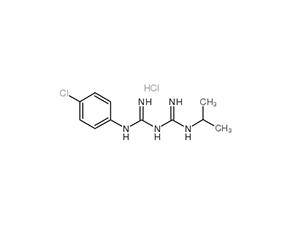
Proguanil hydrochloride
CAS No. 637-32-1
Proguanil hydrochloride( Proguanil Hydrochloride | Paludrine | Chloroguanide hydrochloride )
Catalog No. M18939 CAS No. 637-32-1
Proguanil Hydrochloride is a biguanide compound which metabolizes in the body to form cycloguanil, an anti-malaria agent.
Purity : >98% (HPLC)
 COA
Datasheet
HNMR
HPLC
MSDS
Handing Instructions
COA
Datasheet
HNMR
HPLC
MSDS
Handing Instructions
| Size | Price / USD | Stock | Quantity |
| 5MG | 45 | In Stock |


|
| 10MG | 54 | In Stock |
|
| 25MG | 92 | In Stock |
|
| 50MG | 171 | In Stock |
|
| 100MG | 306 | In Stock |
|
| 200MG | 491 | In Stock |
|
| 500MG | 790 | In Stock |
|
| 1G | Get Quote | In Stock |
|
Biological Information
-
Product NameProguanil hydrochloride
-
NoteResearch use only, not for human use.
-
Brief DescriptionProguanil Hydrochloride is a biguanide compound which metabolizes in the body to form cycloguanil, an anti-malaria agent.
-
DescriptionProguanil Hydrochloride is a biguanide compound which metabolizes in the body to form cycloguanil, an anti-malaria agent.Upon hydrolysis, proguanil is converted to its active cyclic triazine metabolite, cycloguanil, by a cytochrome P450 dependent reaction. Cycloguanil selectively inhibits the bifunctional dihydrofolate reductase-thymidylate synthase of plasmodium parasite, thereby disrupting deoxythymidylate synthesis and ultimately blocking DNA and protein synthesis in the parasite.(In Vitro):Proguanil per se has only weak antimalarial activity in vitro (IC50=2.4-19 μM), and its effectiveness depends on the active metabolite Cycloguanil (IC50=0.5-2.5 nM). The Cycloguanil is a dihydrofolate reductase (DHFR) inhibitor. The combination of Atovaquone and Proguanil is synergistic in vitro. Both drugs also have activity against gametocytes and pre-erythrocytic (hepatic) stages of malaria parasites.Proguanil acts as a biguanide rather than as its metabolite Cycloguanil (a parasite dihydrofolate reductase [DHFR] inhibitor) to enhance the Atovaquone effect. Proguanil-mediated enhancement is specific for Atovaquone, since the effects of other mitochondrial electron transport inhibitors, such as Myxothiazole and Antimycin, are not altered by inclusion of Proguanil.5-HT3 receptor responses are reversibly inhibited by Proguanil, the metabolite 4-chlorophenyl-1-biguanide (CPB) and the active metabolite Cycloguanil (CG), with an IC50 of 1.81, 1.48 and 4.36 μM, respectively.(In Vivo):Proguanil (p.o.; 2.9 mg/kg body weight; daily for 5 days and 6 weeks respectively) shows mild degenerative changes for five days, while shows severe degenerative changes for six weeks in wistar strain albino rats.Serum testosterone level is significantly decreased for proguanil treatment rats.Administration of Malarone (atovaquone and proguanil) to experimentally B. gibsoni infected two dogs in chronic stage and three dogs in acute stage results in decrease in parasitemia, and clinical improvements are observed.
-
In VitroProguanil per se has only weak antimalarial activity in vitro (IC50=2.4-19 μM), and its effectiveness depends on the active metabolite Cycloguanil (IC50=0.5-2.5 nM). The Cycloguanil is a dihydrofolate reductase (DHFR) inhibitor. The combination of Atovaquone and Proguanil is synergistic in vitro. Both drugs also have activity against gametocytes and pre-erythrocytic (hepatic) stages of malaria parasites.Proguanil acts as a biguanide rather than as its metabolite Cycloguanil (a parasite dihydrofolate reductase [DHFR] inhibitor) to enhance the Atovaquone effect. Proguanil-mediated enhancement is specific for Atovaquone, since the effects of other mitochondrial electron transport inhibitors, such as Myxothiazole and Antimycin, are not altered by inclusion of Proguanil. 5-HT3 receptor responses are reversibly inhibited by Proguanil, the metabolite 4-chlorophenyl-1-biguanide (CPB) and the active metabolite Cycloguanil (CG), with an IC50 of 1.81, 1.48 and 4.36 μM, respectively.
-
In VivoProguanil (p.o.; 2.9 mg/kg body weight; daily for 5 days and 6 weeks respectively) shows mild degenerative changes for five days, while shows severe degenerative changes for six weeks in wistar strain albino rats.Serum testosterone level is significantly decreased for proguanil treatment rats.Administration of Malarone (Atovaquone and Proguanil) to experimentally B. gibsoni infected two dogs in chronic stage and three dogs in acute stage results in decrease in parasitemia, and clinical improvements are observed.
-
SynonymsProguanil Hydrochloride | Paludrine | Chloroguanide hydrochloride
-
PathwayAutophagy
-
TargetAutophagy
-
Recptordihydrofolate reductase|thymidylate synthase|NADH dehydrogenase
-
Research Area——
-
Indication——
Chemical Information
-
CAS Number637-32-1
-
Formula Weight290.19
-
Molecular FormulaC11H17Cl2N5
-
Purity>98% (HPLC)
-
Solubility——
-
SMILESCl.Clc1ccc(NC(=N)NC(=N)NC(C)C)cc1
-
Chemical Name(1E)-1-[amino-(4-chloroanilino)methylidene]-2-propan-2-ylguanidine;hydrochloride
Shipping & Storage Information
-
Storage(-20℃)
-
ShippingWith Ice Pack
-
Stability≥ 2 years
Reference



-
Sulfanilamide
Sulfanilamide is a competitive inhibitor for bacterial enzyme?dihydropteroate synthetase?with?IC50?of 320 μM.
-
Neriifolin
Neriifolin (17β-Neriifolin), a cardiac glycoside extracted from the unripe fruit of Cerbera manghas, is a Na+K+-ATPase inhibitor with anticancer activity that inhibits cell proliferation by suppressing HOXA9-dependent gene expression and inducing apoptosis in the human acute myeloid cell line, THP-1.
-
2,2-Dihydroxy chalco...
2,2'-Dihydroxy chalcone is a potent inhibitor of β-glucuronidase (IC50=1.6±0.2 μM) and lysozyme (IC50=1.4±0.2 μM) release from rat neutrophils stimulated with fMLP/CB.2,2'-Dihydroxy chalcone has inhibitory activity against Escherichia coli, Shigella fowleri, Staphylococcus albicans and Staphylococcus aureus.
